Time-Evolution Block Decimation method
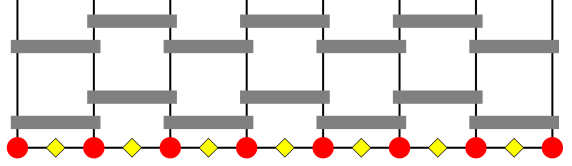
The graphical representation of the TEBD algorithm is shown. Here the Suzuki-Trotter decomposed (first-order) evolution operator operates on the initial MPS for a system of $L=8$. Here the initial state is evolved by $2\delta t$ time.
The time evolution of a quantum state of a strongly correlated
many-body system with time-dependent Hamiltonian is a highly
nontrivial problem. Because of the tremendous success of the DMRG
method in addressing the equilibrium properties of strongly
correlated systems, different attempts have been made to study
non-equilibrium properties using the time-dependent DMRG
method. G. Vidal
developed an algorithm to simulate the time evolution of the
many-body states. In the algorithm, the truncated
Hilbert space dynamically adapts itself for better accuracy. This
algorithm is called the time-evolving block decimation (TEBD), which
fits perfectly with the MPS framework.
The essential technique of TEBD is to write the time evolution operator
$U(\delta t) = e^{-iH\delta t}$ (where $\hbar$ is considered to be
$1$), for a small time
$\delta t$ using Suzuki-Trotter (ST) decomposition. If
the Hamiltonian of interest contains only the nearest-neighbor
interactions, then the Hamiltonian can be re-written in terms of
local two site terms as
\begin{equation}
H = \sum_i h_{(2i-1), 2i} + \sum_i h_{2i, (2i+1)} = H_{odd} + H_{even}.
\end{equation}
Here all $H_{odd}$ or $H_{even}$ terms commute among themselves but,
$h_{(2i-1), 2i}$ and $ h_{2i, (2i+1)}$ do not commute in general since they share a
common site $2i$. This non-commutative nature gives rise to an error in the ST
decomposed time evolution operator. The first order Suzuki-Trotter (ST(1)) decomposed
$U(\delta t)$ can be written as
\begin{equation}
e^{-iH\delta t} = e^{-iH_{odd}\delta t} + e^{-iH_{even}\delta t}+ O(\delta t ^2).
\end{equation}
So, the time evolved wavefunction becomes
\begin{equation}\label{eq:tebd}
|\Psi(t+\delta t)\rangle = e^{-iH_{odd}\delta t} e^{-iH_{even}\delta t} |\Psi(t)\rangle
\end{equation}
In the MPS description of the wavefunction, the two site operators in $H_{odd}$
or $H_{even}$ can be operated independently since they commute with each other.
After operating a two-site
operator, the local dimension increases by $d^2$ times and the MPS description vanishes
on those two sites. This tells us that at every time step, the dimension increases
exponentially. However, applying the SVD technique, one can reduce the dimension by truncating the
singular value spectrum as before and also restore the MPS description after each time
step. Now, discretizing the total time of evolution $t = N\delta t$,
the repeated operation of the Eq. \ref{eq:tebd} on the initial state can evolve the state to time $t$.
An example of this method of time evolution is depicted in
figure for $N=2$. The ST decomposition described above works if the
Hamiltonian only has the nearest-neighbor terms.
In general, if the Hamiltonian has the
next-nearest-neighbor terms, the ST decomposition of the evolution operator is done with
three-site local operators instead of two.
Note that during every step of time evolution, entanglement builds
up in the system. In the process of truncation in SVD, the error
also builds up in the wave-function. Apart from this, errors also arise from the ST
decomposition, which is of the order of $\delta t^2$. This error can
be reduced by considering a very short time step $\delta t$. The
error in ST decomposition can be further reduced by considering
higher-order ST decomposition since in ST($n$), the error comes of
the order of $\delta t^{n+1}$. In the following, an ST($2$)
decomposition is shown.
\begin{equation}
e^{-iH\delta t} = e^{-iH_{odd}\delta t/2} e^{-iH_{even}\delta t} e^{-iH_{odd}\delta t/2}+ O(\delta t ^3).
\end{equation}
Using small time steps and higher-order ST decomposition, this error can also be
significantly minimized. Nevertheless, considering all these sources of errors, the
accessible time scale allows us to study the system of interest efficiently. There is also a TEBD algorithm for infinite
systems (iTEBD).
Related references
-
Ulrich Schollwöck, The density-matrix renormalization group in the age of matrix product states, Annals of Physics 326, 96 (2012).
-
Sebastian Paeckel, Thomas Köhler, Andreas Swoboda, Salvatore R. Manmana, Ulrich Schollwöck, Claudius Hubig, Time-evolution methods for matrix-product states, Annals of Physics 411, 167998 (2019).
-
Guifré Vidal, Efficient Simulation of One-Dimensional Quantum Many-Body Systems, Phys. Rev. Lett. 93, 040502 (2004).
-
www.tensors.net
Free resources
-
ITensors: High-Performance Tensor Software Inspired By Tensor Diagrams, developed by Steve White, Miles Stoudenmire, et al.
-
TeNPy: Tensor Network Python, developed by the group of Frank Pollmann.