Cluster Mean Field Theory
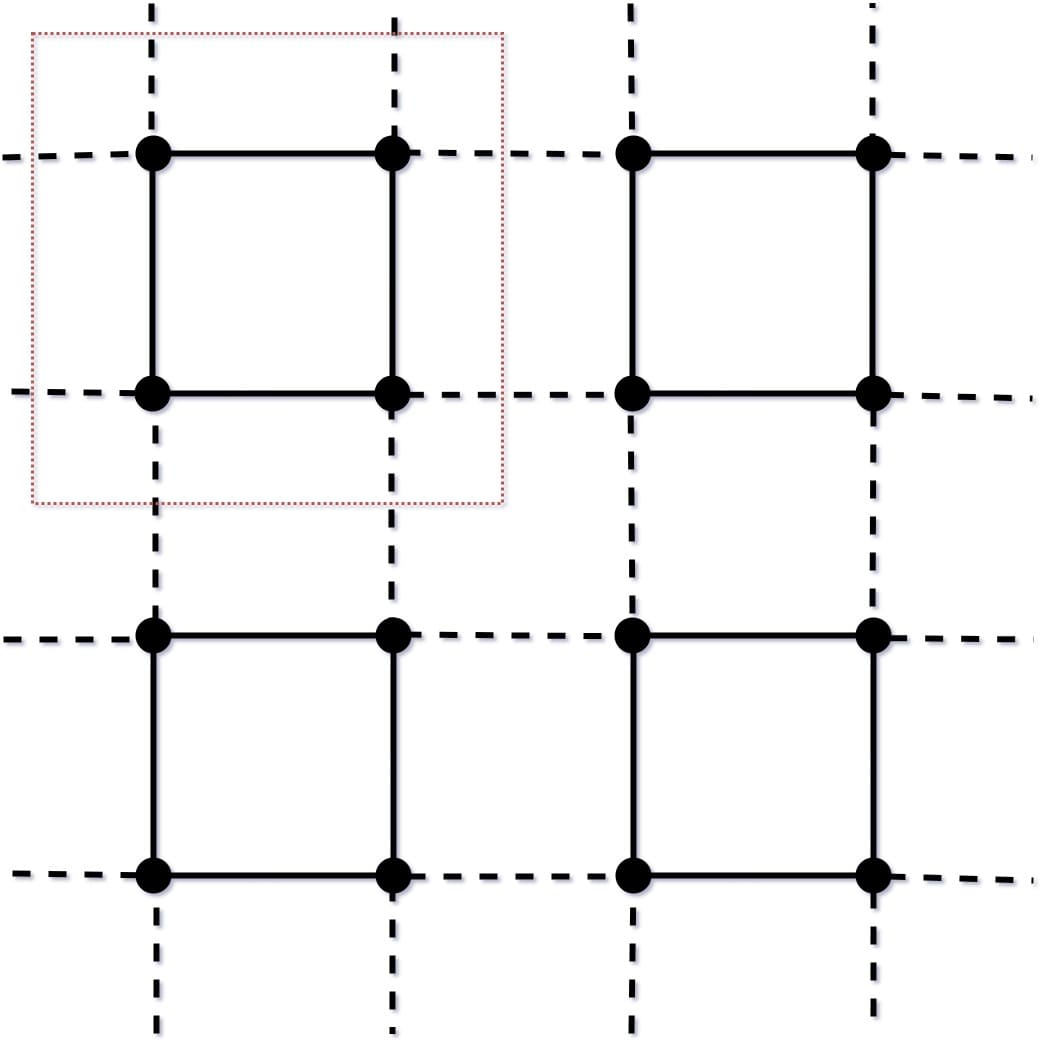
A two-dimensional square lattice is partitioned with the $2\times 2$ clusters. The dotted box represents a unit cluster by the repetition of which the entire lattice is made. In the CMFT approach, the solid lines are treated exactly and the dashed lines connecting clusters are treated in a mean-field way.
The Cluster Mean-Field Theory (CMFT) approach is one of the simplest
methods which utilizes the ED method and the mean-field (MF)
decoupling approximations to simplify a
many-body problem. In this method, one divides the entire many-body
system into small small clusters of finite size, as shown in the figure above.
While the Hamiltonian of the individual cluster is treated exactly,
the couplings between the clusters are treated in a mean-field way.
Please read the related references for more details and examples.
Let's consider an example of the Bose Hubbard model of interacting bosons as
\begin{equation}\label{eq:bhham2}
{H} = -\sum\limits_{\langle i,j \rangle}t_{i,j}(a^\dagger_{i}a_{j}+ H.c.) + \frac{U}{2}\sum\limits_i{n}_{i}({n}_{i} - 1) - \sum\limits_i\mu_i n_{i}
\end{equation}
Using the MF approximation, one can write the annihilation operator as
\begin{equation}
a_i = \psi_i + \delta a_i
\end{equation}
where $\psi=\langle a\rangle$ and $\delta a_i$ is a small fluctuation around the mean value.
This approximation transforms the hopping term as
\begin{equation}\label{eq:mfhop}
a_i^\dagger a_j = a_i^\dagger\psi_j + a_j\psi_i^* - \psi_i^*\psi_j
\end{equation}
by neglecting the terms quadratic in $\delta a_i$, which we consider to be infinitesimal.
Using Eq. \ref{eq:mfhop} the Hamiltonian (\ref{eq:bhham2}) becomes
$H \approx \sum\limits_iH_{MF}$ where
\begin{equation}\label{eq:mftham}
H_{MF} = -\mu n + \frac{U}{2}{n}({n} - 1) -zt(a^\dagger\psi + a\psi^* - \psi^*\psi)
\end{equation}
T his is a single site Hamiltonian. The ${z}$ is the lattice
co-ordination number. The above Hamiltonian breaks the $U(1)$
symmetry for all the $\psi\neq0$ reflecting the appearance of the SF
phase where $\psi$ represents the superfluid order parameter. The
$\psi$ can be obtained self-consistently through an iterative
process to get the ground state of the system. The $H_{MF}$
estimates the critical point for the SF-MI transition corresponding
to the BH model to be $(U/zt)_c = 5.83$. Note that in the simple MF
approach, the entire Hamiltonian is decomposed into single site
Hamiltonian and the accuracy of the results increases with the
dimension of the system. Being a single site method, this method
does not demand computational complexity. However, for the same
reason, it ignores the off-site correlations, which are essential to
capture useful insights about the system.
The CMFT approach circumvents this problem as one considers a
cluster of sites instead of a single site as opposed to the simple
MF approach. As shown in the figure above, the cluster of sites
connected by solid lines is treated exactly, whereas the edges
connecting two clusters marked by dashed lines are treated in a
mean-field way. Using this
approximation the resulting Bose Hubbard Hamiltonian can be written as
\begin{equation}
H \approx \sum_c H_{CMF}
\end{equation}
where $c$ represents the cluster index. Here $H_{CMF}$
is cluster mean-field Hamiltonian that consists of two parts i.e.
\begin{equation}\label{eq:bhcmf}
H_{CMF} = H_e + H_{mf}.
\end{equation}
Here, $H_e$ represents the exact part which is given as
\begin{equation}
\hat{H}_e = -t\sum\limits_{\langle i,j \rangle} a^\dagger_{i}a_{j} + \frac{U}{2}\sum\limits_i{n}_{i}({n}_{i} - 1) -\mu\sum\limits_i n_i,
\end{equation}
where $i,j$ are sites within the cluster. $H_{mf}$ represents the mean-field part
of the Hamiltonian and is given as
\begin{equation}
H_{mf} = -t\sum\limits_{\langle i,j' \rangle}(a_i^\dagger\phi_{j'} + \phi_i^* a_{j'} -\phi_i^* \phi_{j'})
\end{equation}
where $i$ ($j'$) are site indices of the edges of the cluster (neighboring clusters).
Similar to the simple MF approach, the values of $\psi_i$ are
obtained self-consistently in the CMFT approach as well. In this
method, the accuracy of the results increases with the cluster size.
Unlike the MF approach, the CMFT allows for the calculation of
off-site correlation functions within the cluster. This makes the
CMFT method more accurate than the simple mean-field theory approach
and can capture the qualitative picture of the system with less
computing effort than the powerful Quantum Monte Carlo
method.
To compare the CMFT method with other numerical methods, I have shown the first Mott lobe of the Bose Hubbard model in the
DMRG chapter, calculated using different methods. Also see reference 1 for more comparisons.
Related references
-
T. McIntosh, P. Pisarski, R. J. Gooding, E. Zaremba, Multi-site mean-field theory for cold bosonic atoms in optical lattices, Phys. Rev. A 86, 013623 (2012).
-
, Augustine Kshetrimayum, Tapan Mishra, Two-body repulsive bound pairs in a multibody interacting Bose-Hubbard model, Phys. Rev. A 102, 023312 (2020).
-
Sayan Lahiri, , Manpreet Singh, Tapan Mishra, Mott insulator phases of nonlocally coupled bosons in bilayer optical superlattices, Phys. Rev. A 101, 063624 (2020).
-
Manpreet Singh, , B. K. Sahoo, Tapan Mishra, Quantum phases of constrained dipolar bosons in coupled one-dimensional optical lattices, Phys. Rev. A 96, 053604 (2017).