Numerical Methods
The complex many-body systems are often intractable using analytical methods, and hence one has to rely on numerical techniques. One obvious method is to solve the many-body Schrödinger equation using the exact diagonalization (ED) methods. However, due to the exponential growth of the Hilbert space dimension with the system size, it is absolutely impossible to access the physics of a larger system. To circumvent this problem, several powerful methods have been developed to study the quantum many-body systems such as Density Matrix Renormalization Group (DMRG) method and other Matrix Product State (MPS) based methods. In this page, I will provide an overview of these numerical methods.
Our contributions →
6. Semi-classical TEBDClick on a topic to jump to that section.
1. Exact Diagonalization
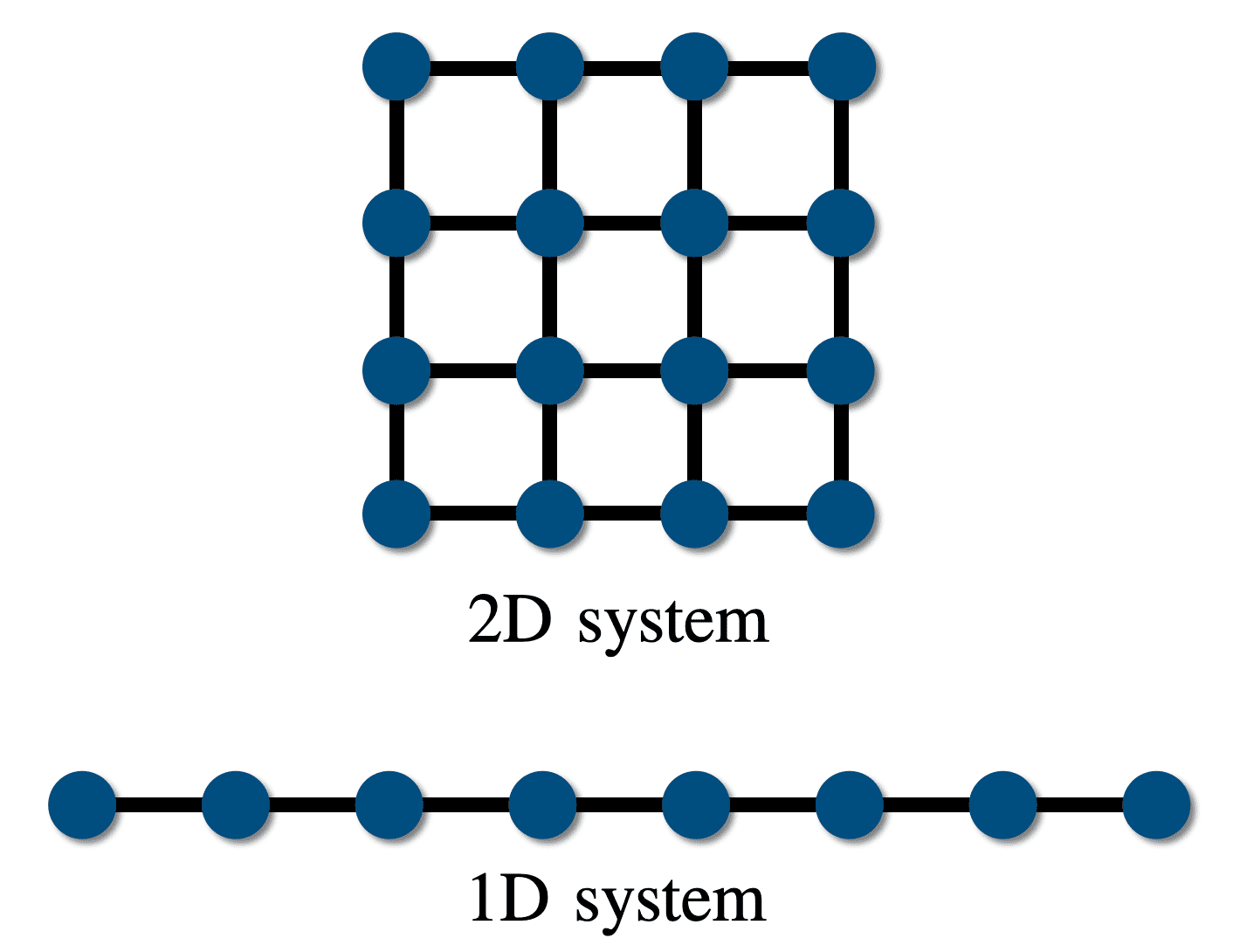
The exact diagonalization (ED) method allows us to calculate the full spectrum of the Hamiltonian describing a particular system. The method is based on three major steps, namely (a) create appropriate basis states, (b) compute the matrix elements of the Hamiltonian using the basis states and (c) diagonalize the Hamiltonian matrix to obtain the eigenspectrum. With the help of the eigenstates and eigenenergies, we can study the physical properties of the system. However, as mentioned above, due to the exponential growth of the Hilbert space dimension with the system size, it is absolutely impossible to access the physics of a larger system. Lanczos or Arnoldi method makes it little more efficient if we are only interested in lowe-lying states, which is often sufficient for qualitative studies.
2. Cluster Mean Field Theory
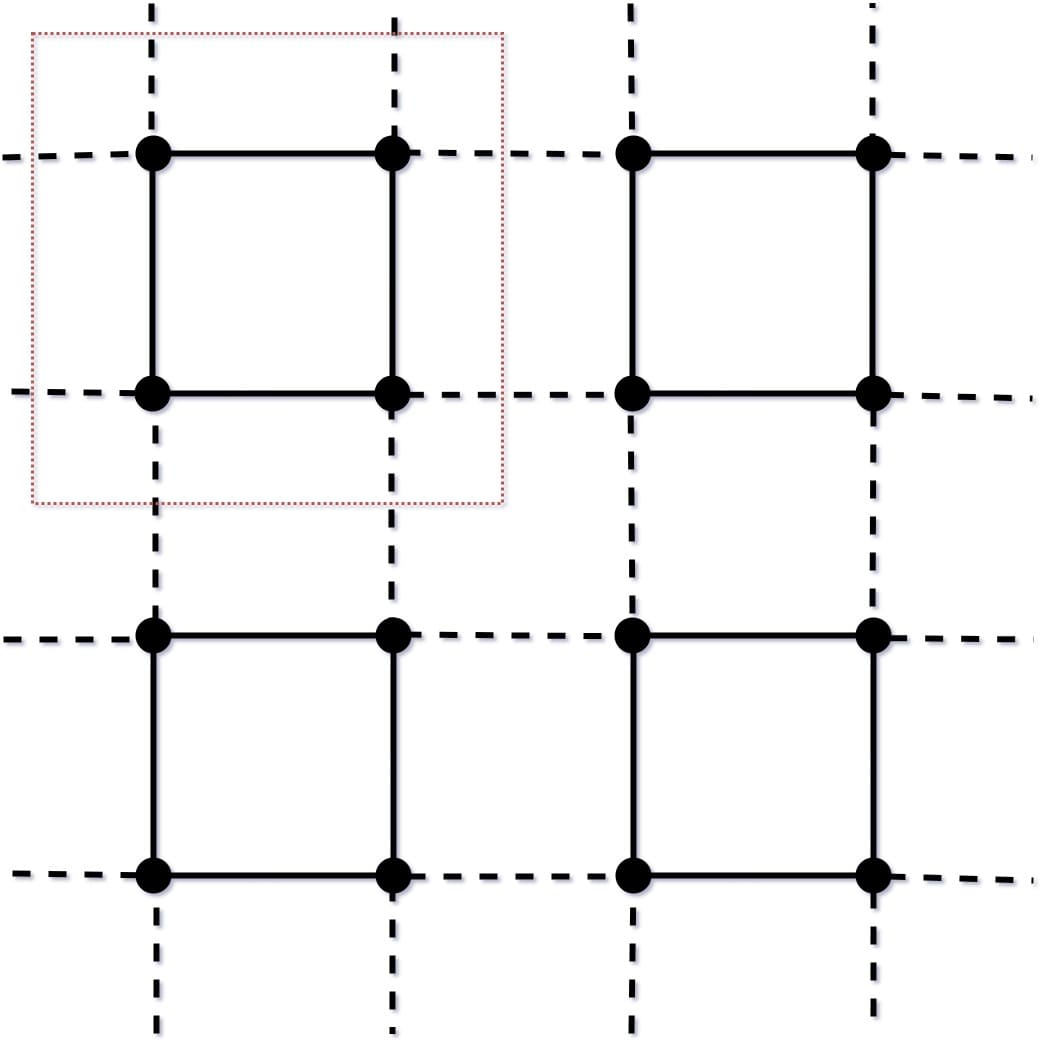
The Cluster Mean-Field Theory (CMFT) approach is one of the simplest methods which utilizes the ED method and the mean-field (MF) decoupling approximations to simplify a many-body problem. In this method, one divides the entire many-body system into small small clusters of finite size, as shown in the figure. While the Hamiltonian of the individual cluster is treated exactly, the couplings between the clusters are treated in a mean-field way. In this method, the accuracy of the results increases with the cluster size. Unlike the MF approach, the CMFT allows for the calculation of off-site correlation functions within the cluster. This makes the CMFT method more accurate than the simple mean-field theory approach and can capture the qualitative picture of the system with less computing effort than the powerful Quantum Monte Carlo method.
3. Matrix Product State
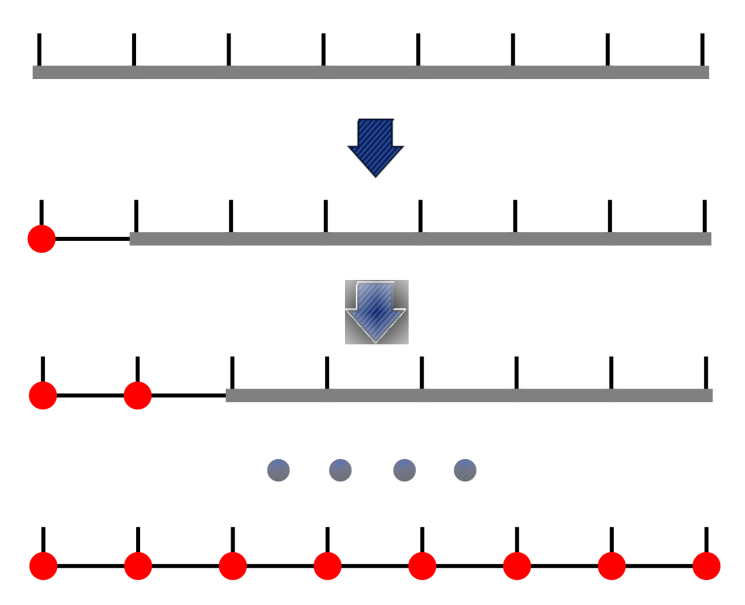
The matrix product states (MPSs) are widely used in quantum information theory and theoretical physics, especially to study the strongly correlated systems. These are simple and efficient tensor network representation of the quantum many-body states. An example of such state is one-dimensional AKLT state that can be converted to MPS exactly. A most general wave function for a system of $L$ sites can be written as $|\Psi\rangle = $ $\sum\limits_{\sigma_1,...,\sigma_L} c_{\sigma_1...\sigma_L} {|\sigma_1,...,\sigma_L\rangle}$. In MPS form, the exponentially many coefficients $c_{\sigma_1...\sigma_L}$ are compressed and the state is represented as $|\Psi\rangle =$ $\sum\limits_{a_1,...,a_L} A_{a_1}^{\sigma_1}$ $A_{a_1,a_2}^{\sigma_2}...A_{a_{L-2},a_{L-1}}^{\sigma_{L-1}} A_{a_{L-1}}^{\sigma_{L}}$ ${|\sigma_1,...,\sigma_L\rangle}$. The sungular value decomposition (SVD) is used to perform this compression.
4. Density Matrix Renormalization Group
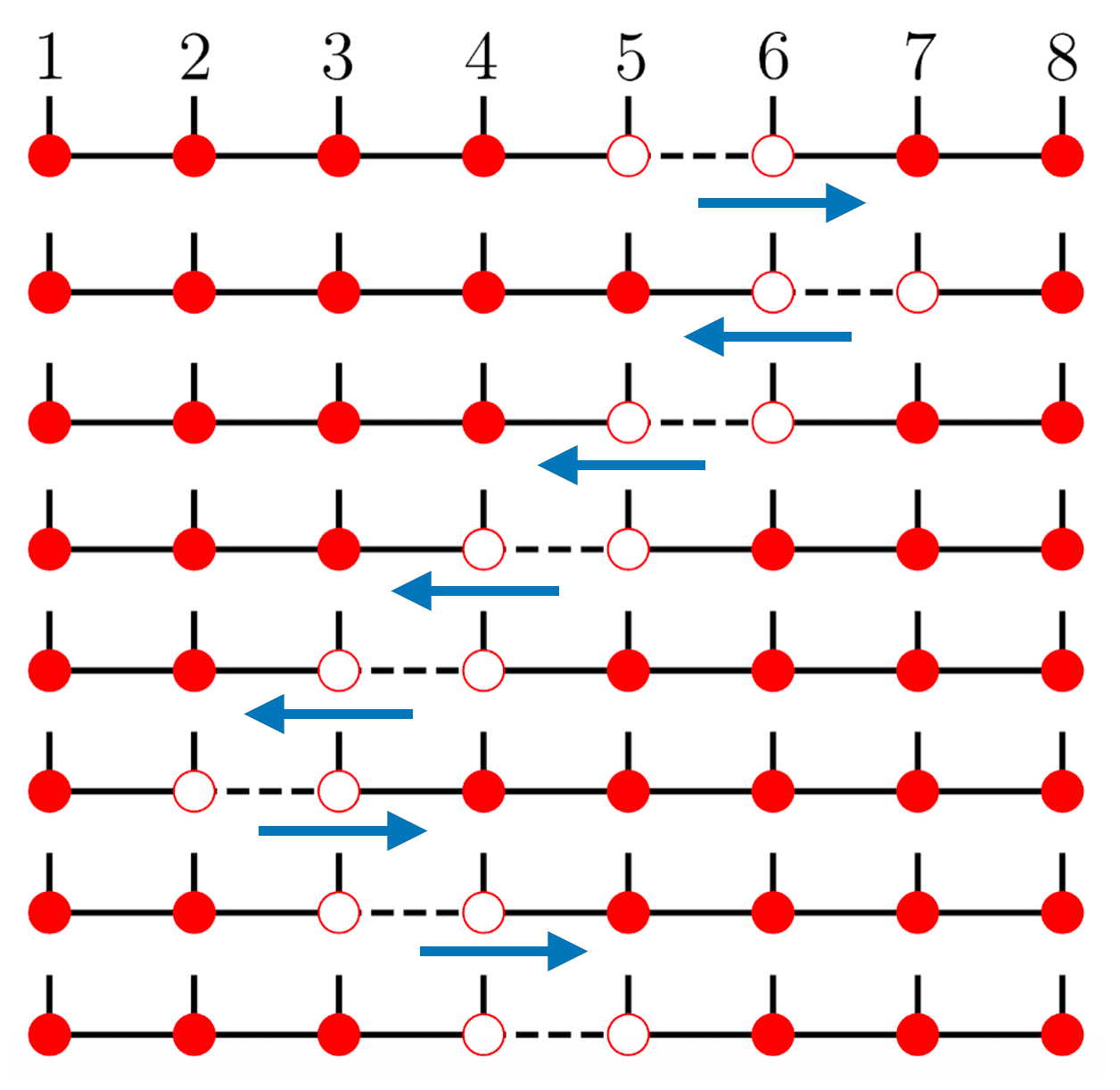
The Density Matrix renormalization group (DMRG) method is the prescription to prevent the exponential growth of the Hilbert space while providing accurate results for low dimensional systems. Steve White proposed the method in 1992 as an improvement over the numerical renormalization group (NRG). The method finds the ground state of the system by variational approximation through local optimization. As a further development, the DMRG method was then applied to MPSs that increased the flexibility and power of the DMRG method by manyfold. The key idea here is to minimize the bond dimension ($a_i$) of the MPS by eliminating a part of the singular value spectrum that is negligible in weight. For example, in the low entangled states like the gapped state, the singular values ($\lambda_k$) decrease exponentially with its spectral position ($k$), \begin{equation} \lambda_k \propto e^{-\alpha k}, ~~~ \alpha > 0. \end{equation}
5. Time-Evolution Block Decimation
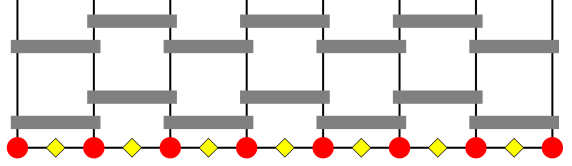
The time evolution of a quantum state of a strongly correlated many-body system with time-dependent Hamiltonian is a highly nontrivial problem. Because of the tremendous success of the DMRG method in addressing the equilibrium properties of strongly correlated systems, different attempts have been made to study non-equilibrium properties using the time-dependent DMRG method. G. Vidal developed an algorithm to simulate the time evolution of the many-body states. In the algorithm, the truncated Hilbert space dynamically adapts itself for better accuracy. This algorithm is called the time-evolving block decimation (TEBD), which fits perfectly with the MPS framework.
6. Semi-classical TEBD
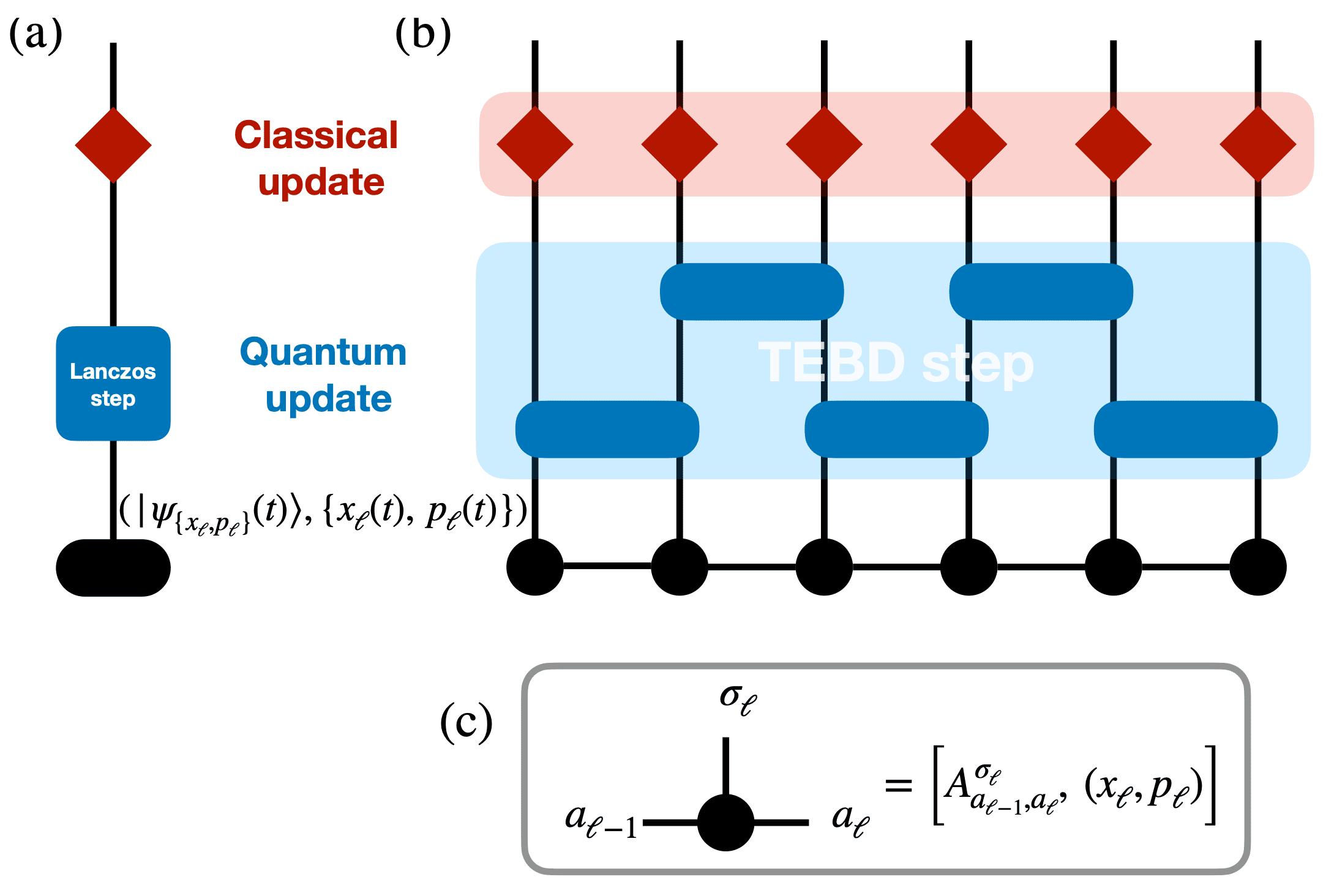
Simulating electron-phonon systems numerically is particularly demanding because the quantum phonon Hilbert space grows rapidly with the number of phonon modes. To address this, we developed a hybrid semi-classical time-evolving block decimation (TEBD) approach combining the multi-trajectory Ehrenfest (MTE) method for the phonons with the full quantum TEBD for the electronic (or bosonic) degrees of freedom.
This hybrid MTE+TEBD method treats phonons semi-classically via stochastic trajectories while retaining the full quantum description of the strongly correlated electrons through the MPS framework. It allows access to much larger system sizes than exact diagonalization methods, while capturing the key effects of strong electron-phonon coupling. We have applied this method to study disordered systems coupled to Einstein phonons, benchmarking it against Lanczos and full exact diagonalization methods.
Learn more from the reference →
- H. G. Menzler*, S. M.*, and F. Heidrich-Meisner, Hybrid quantum-classical matrix-product state and Lanczos methods for electron-phonon systems with strong electronic correlations, arXiv:2512.10899 (2025) (*equal contribution).