Matrix Product States
The matrix product states (MPS) are the widely used in quantum information
theory and theoretical physics, especially to study the strongly correlated matter.
These are simple tensor network representations of the quantum many-body states. An
example of such state is one-dimensional AKLT
state that can be converted to MPS exactly. This powerful way of representing many-body states gives
us a perfect variational class to incorporate in the density matrix renormalization
group (DMRG) method. We briefly explain the salient features of this method in the following.
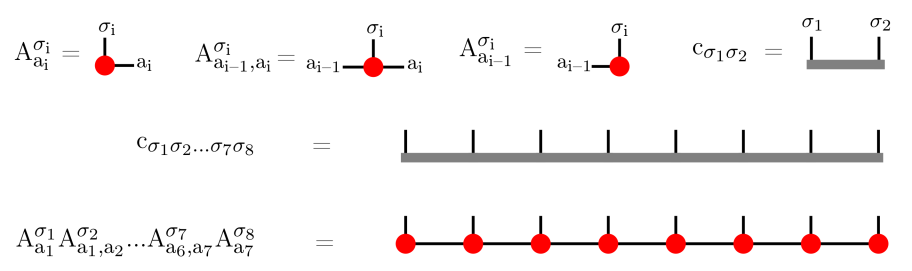
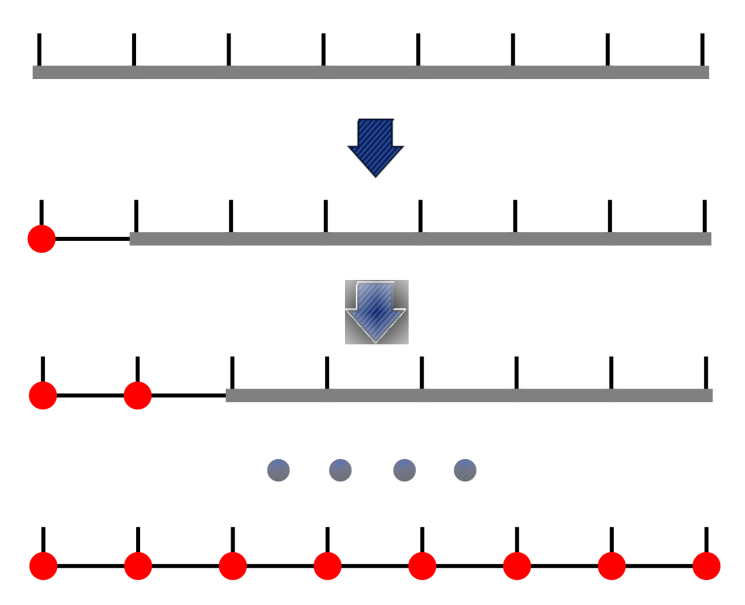

Figure portrays the graphical representation of a general state and matrix product state as defined in Eqs. \ref{eq:genState} and \ref{eq:lcMPS} respectively for a system of length $L=8$. The top row of the figure shows the elements of the matrix product state.
The transformation of a many-body state to an MPS relies on the well known singular value decomposition (SVD).
Consider a one-dimensional system with open boundary condition consists of $L$ number of sites and a $d$-dimensional
local state spaces $\{\sigma_i\}$ where $i$ is the lattice index. A most general wave
function for this system can be written as
The number of coefficients $c_{\sigma_1...\sigma_L}$ is equal to the dimension of the
Hilbert space of the system which increases exponentially with $L$. Now, a matrix can
represent the coefficient vector as
\begin{equation}\label{eq:genState}
|\Psi\rangle = \sum\limits_{\sigma_1,...,\sigma_L} c_{\sigma_1...\sigma_L} {|\sigma_1,...,\sigma_L\rangle}.
\end{equation}
\begin{equation}
c_{\sigma_1...\sigma_L} = c_{\sigma_1,(\sigma_2...\sigma_L)}.
\end{equation}
An SVD performed on this matrix leads to ,
\begin{equation}
c_{\sigma_1...\sigma_L} = c_{\sigma_1,(\sigma_2...\sigma_L)} = \sum\limits_{a_1}U_{\sigma_1,a_1} S_{a_1,a_1} (V^\dagger)_{a_1,(\sigma_2...\sigma_L)}.
\end{equation}
Here $U$ and $V$ are unitary matrices and $S$ is a diagonal matrix containing the singular values.
Now the $a_1$ index of the $S_{a_1,a_1} $ and
$ (V^\dagger)_{a_1,(\sigma_2...\sigma_L)}$ can be contructed and transformed into
$c_{a_1,(\sigma_2...\sigma_L)}$. By renaming $U_{\sigma_1,a_1}$ with
$A_{a_1}^{\sigma_1}$, the above equation becomes
\begin{equation}
c_{\sigma_1...\sigma_L} = \sum\limits_{a_1} A_{a_1}^{\sigma_1} c_{a_1,(\sigma_2...\sigma_L)}
\end{equation}
Note that, we have not discurded anythig to compress in this SVD process. We will discuss the compression in the DMRG chapter.
Then, by transforming $c_{a_1,(\sigma_2...\sigma_L)}$ to
$c_{(a_1\sigma_2),(\sigma_3...\sigma_L)}$, and after an SVD we have
\begin{equation}
c_{\sigma_1...\sigma_L} = \sum\limits_{a_1} \sum\limits_{a_2} A_{a_1}^{\sigma_1} U_{(a_1\sigma_2),a_2} S_{a_1,a_2}(V^\dagger)_{a_2,(\sigma_3...\sigma_L)}.
\end{equation}
Contracting $a_2$ in $S$ and $V$, the above equation can be modified as
\begin{equation}
c_{\sigma_1...\sigma_L} = \sum\limits_{a_1} \sum\limits_{a_2} A_{a_1}^{\sigma_1} A_{a_1,a_2}^{\sigma_2} c_{(a_2\sigma_3),(\sigma_4...\sigma_L)}.
\end{equation}
This process is repeated until the other end of the lattice is reached. Finally, the
wave function transforms into an MPS which is given by
\begin{equation}\label{eq:lcMPS}
|\Psi\rangle = \sum\limits_{a_1,...,a_L} A_{a_1}^{\sigma_1} A_{a_1,a_2}^{\sigma_2}...A_{a_{L-2},a_{L-1}}^{\sigma_{L-1}} A_{a_{L-1}}^{\sigma_{L}}{|\sigma_1,...,\sigma_L\rangle}.
\end{equation}
In the above equation, $a_i$ are called bond indices, whereas $\sigma_i$ are the
physical indices.
The MPS can be conveniently represented in a graphical way. In figure above, we depict an
MPS and different elements of an MPS in graphical form for a system of length $L=8$.
We also represent the above formalism to create the MPS graphically in figure below.
The graphical representation of the left canonical MPS formation using SVD process for a system of length $L=8$.
The MPS representation of states is categorized into three types. The one shown in Eq. \ref{eq:lcMPS} is called Left-canonical MPS.
There are two other representations of the MPS called the right-canonical MPS and
the mixed-canonical MPS. The procedure of creating right-canonical MPS is similar to that of the
Left-canonical MPS. However, the right-canonical MPS is developed
by contracting from right to left instead of left to right.
The Right-canonical MPS of $|\Psi\rangle$ can be written as
\begin{equation}\label{eq:rcMPS}
|\Psi\rangle = \sum\limits_{a_1,...,a_L} B_{a_1}^{\sigma_1} B_{a_1,a_2}^{\sigma_2}...B_{a_{L-2},a_{L-1}}^{\sigma_{L-1}} B_{a_{L-1}}^{\sigma_{L}}{|\sigma_1,...,\sigma_L\rangle}.
\end{equation}
where $B_{a_{i-1},a_i}^{\sigma_i}$ are created from the corresponding $(V^\dagger)$ matrices.
The last variant that we are going to use in the DMRG method is called the Mixed-canonical
MPS. In this scenario, we create an MPS of a state from both left ($1^{st}$ to the $l^{th}$ sites) and
right ($L^{th}$ to $(L-l)^{th}$ sites) ways. A typical Mixed-canonical MPS can be written as
\begin{equation}\label{eq:mcMPS}
|\Psi\rangle = \sum\limits_{a_1,...,a_L} A_{a_1}^{\sigma_1} ... A_{a_{l-1},a_l}^{\sigma_l} S_{a_l,a_{l}} B_{a_{l},a_{l+1}}^{\sigma_{l+1}} ... B_{a_{L-1}}^{\sigma_{L}}{|\sigma_1,...,\sigma_L\rangle}.
\end{equation}
A graphical representation of a Mixed-canonical MPS for $L=8$ is shown in
figure below where we consider $l=4$. Since the representations discussed above
are exact, the total dimension would scale exponentially with $L$.
The graphical representation of a mixed canonical MPS for a system of length $L = 8$ following Eq. \ref{eq:mcMPS}.
Once we have an MPS, the expectation value of an operator or the overlap with
other MPS is very easy to calculate.
For example, consider two left-canonical MPSs $|\Psi\rangle$ and $|\Phi\rangle$
described by the networks of $A^{\sigma_l}$ and $\tilde{A}^{\sigma_l}$ ($a_i$ indices are hidden) matrices respectively.
The overlap between them can be
calculated efficiently by contracting the common indices from one boundary to another (say, $1$ to $ L $):
\begin{equation}
\langle\Phi|\Psi\rangle = \sum_{\sigma_L} \tilde{A}^{\sigma_L\dagger}\left(...\left(\sum_{\sigma_2}\tilde{A}^{\sigma_2\dagger}\left( \sum_{\sigma_1}\tilde{A}^{\sigma_1\dagger} A^{\sigma_1}\right)A^{\sigma_2}\right)...\right) A^{\sigma_L}
\end{equation}
Here we hide the $a_i$ indices for simplicity.
By using a similar prescription, the expectation value of an operator can also be
calculated. As an example consider an $L$ point operator $O = O_1 \otimes O_2 \otimes ... \otimes O_L$.
Note that in most of the cases most of the
on-site operators ($O_i$) will be identity operators. Now the expectation value of
the operator can be written as
\begin{equation}
\langle\Psi|O|\Psi\rangle = \sum_{\sigma_L \sigma_L'} O_L^{\sigma_L \sigma_L'} {A}^{\sigma_L\dagger}~\left(...\left(\sum_{\sigma_2 \sigma_2} O_2^{\sigma_2 \sigma_2'} {A}^{\sigma_2\dagger} \left(\sum_{\sigma_1 \sigma_1'} O_1^{\sigma_1 \sigma_1'} {A}^{\sigma_1\dagger} A^{\sigma_1'}\right){A}^{\sigma_2\dagger}\right)...\right) A^{\sigma_L'}
\end{equation}
We will use all these machineries discussed in this chapter in the DMRG method.
Related references
-
Ulrich Schollwöck, The density-matrix renormalization group in the age of matrix product states, Annals of Physics 326, 96 (2012).
-
www.tensors.net
Free resources
-
ITensors: High-Performance Tensor Software Inspired By Tensor Diagrams, developed by Steve White, Miles Stoudenmire, et al.
-
TeNPy: Tensor Network Python, developed by the group of Frank Pollmann.